
Each player starts with 20 life points; this will be your measure of resilience throughout the duel.
Game rules for Living Hell
Now that you're ready to dive into battle, here's what you need to know to achieve victory.
Game start
Combat basics
20 life
points

5 cards
to start
Additionally, each player receives 5 cards, your first combat tools.

7 cards
maximum
You cannot have more than 7 cards in your hand at the end of your turn. If you have more, you must choose and discard until you have 7.

Add 1 card
each turn
At the beginning of each turn, you'll add a card from your deck, expanding your options.
1.2. The first strike: who starts
To determine who takes the first turn, simply flip a coin. This small gesture can have a big impact on initial strategies.

Attack mechanics
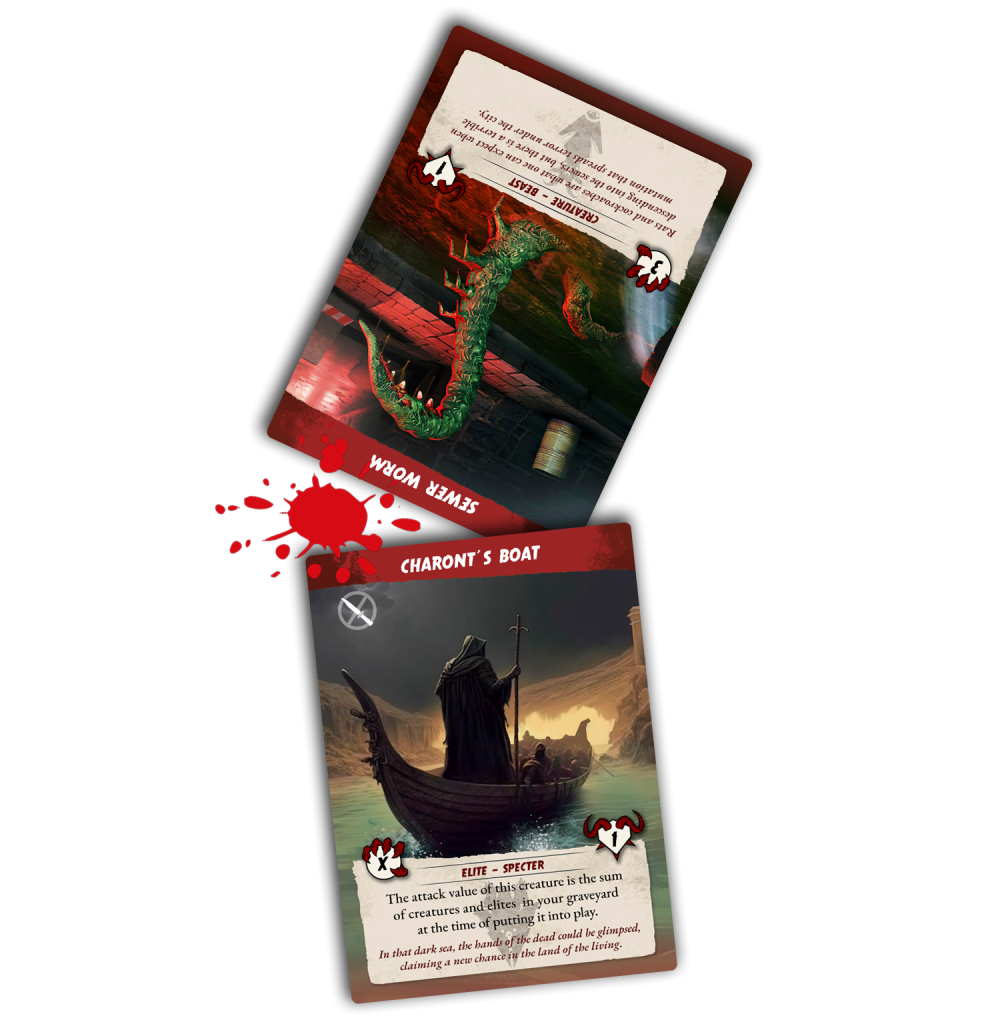
On their turn, each player designates who their creatures attack. Creatures can attack any other creature on the opponent´s field without restrictions or bonuses (except spells or creatures specifying otherwise). There are several ways to damage the opposing player:
- Direct damage, this would be attacking with a creature when the opponent has no creatures on the field. The damage is the total value of the attacking creature’s attack.
- Indirect damage, when your creature attacks one of your opponent’s creatures in attack position with a lower attack value. The damage would be the difference between the attack values. For example, if a creature with an attack of 3 fights against another with an attack of 1, the latter will die, and its controller will receive 2 points of damage.
- Effect damage, due to the effect of a spell or reinforcement card.
Creature positions
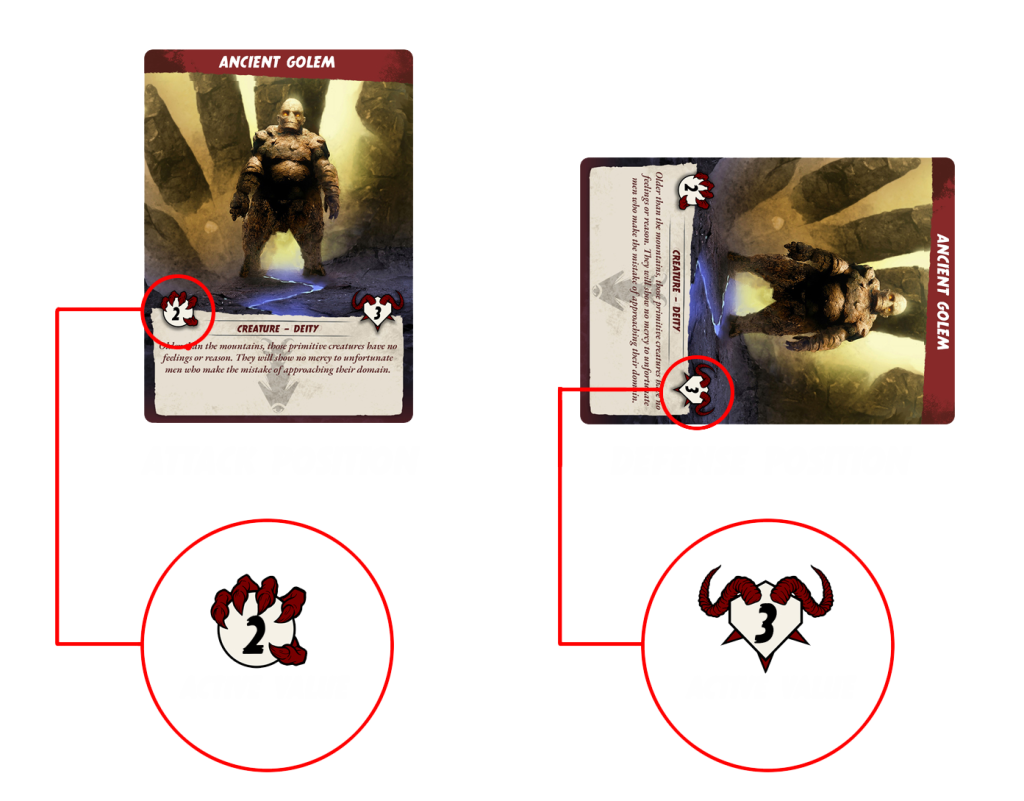
Creatures have two possible positions, which can be changed at the beginning of each turn:
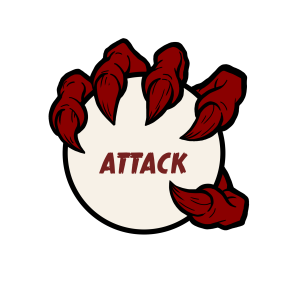
Attack
The creature card is placed in an upright position. In this position, the attack value is used for combat purposes.
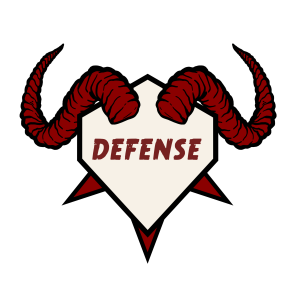
Defense
The creature card is placed in a horizontal position. In this position, the defense value is used for combat purposes.
Consider the following situations:
Defense vs Attack
- A creature in defense position receives a higher attack than its defense value: the creature will die, but the defending player will not receive any damage.
- A creature in defense position receives damage equal to its defense value: it does not die.
Attack vs Attack
- A creature attacks another creature that is in attack position: the one with the higher attack value will destroy the other, and the player will receive the remaining damage.
- If both cards in attack position have the same attack value: both would die without damage to the players.
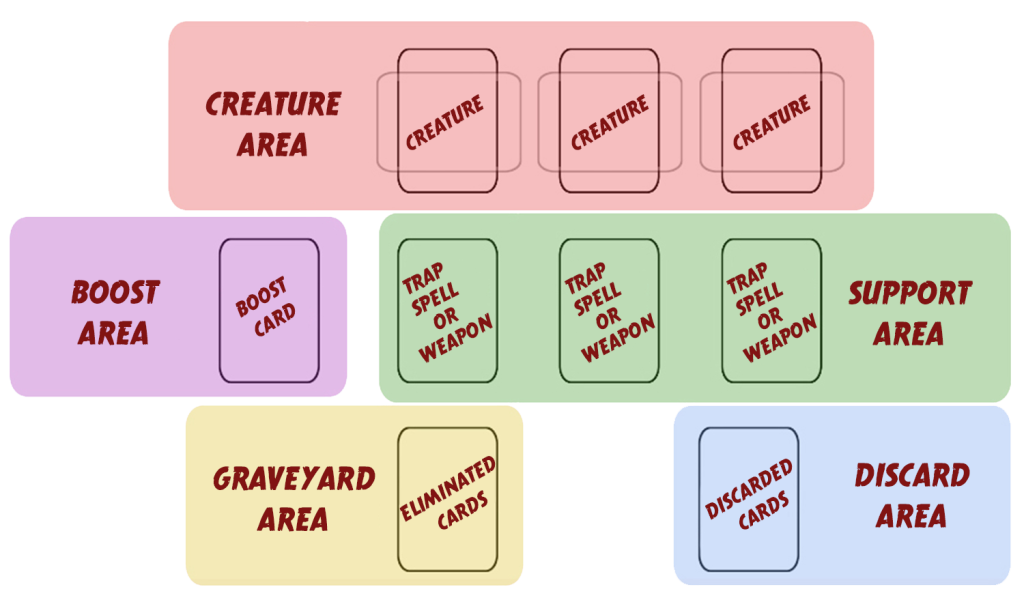
Zones in Living Hell
- Creature Area. The area where creature and Elite cards are placed. The row in which the cards are positioned does not affect damage calculation or effects. You can have up to 3 cards here. Creatures attack.
- Support Area. This is where the player places Trap, Weapon, and in some cases (non-instant) Spell cards. You can have up to 3 cards here. Traps are face-down until their activation.
- Boost Area.Here, boost cards are placed; only one can be present. In cases where there is already a card in the space, it can be replaced by a new boost card, sending the previous one to the graveyard.
- Graveyard Area. When creature cards are destroyed and when trap and magic cards are consumed, they are sent face-up to this space. In this area, creatures are counted for the invocation of Baal.
- Discard Area. When a card is discarded, it goes directly to this area. There are some spells that can bring a card back into play from this area.
In both your and your opponent’s playing field, there is a limit of 3 creatures in play, 3 spells, traps, or weapons, and 1 boost card.
Invocations and special rules
Summoning one creature per turn
However, there are spells or boost cards that allow, in an extraordinary manner, to summon more creatures in a single turn.
First turn of play
Creatures summoned during the first turn of the game cannot attack on that turn. In subsequent turns, creatures can attack as soon as they are put into play (there is no summoning sickness).
Cards face-up
Cards are revealed when played and remain face-up.
Trap cards
They are played face-down.

Victory conditions

Victory
The player who reduces the opponent's life points to zero or leaves them without cards wins

Tie
Both players have only one creature card with the same attack value or spells and weapons without the possibility of being equipped or attacking.